

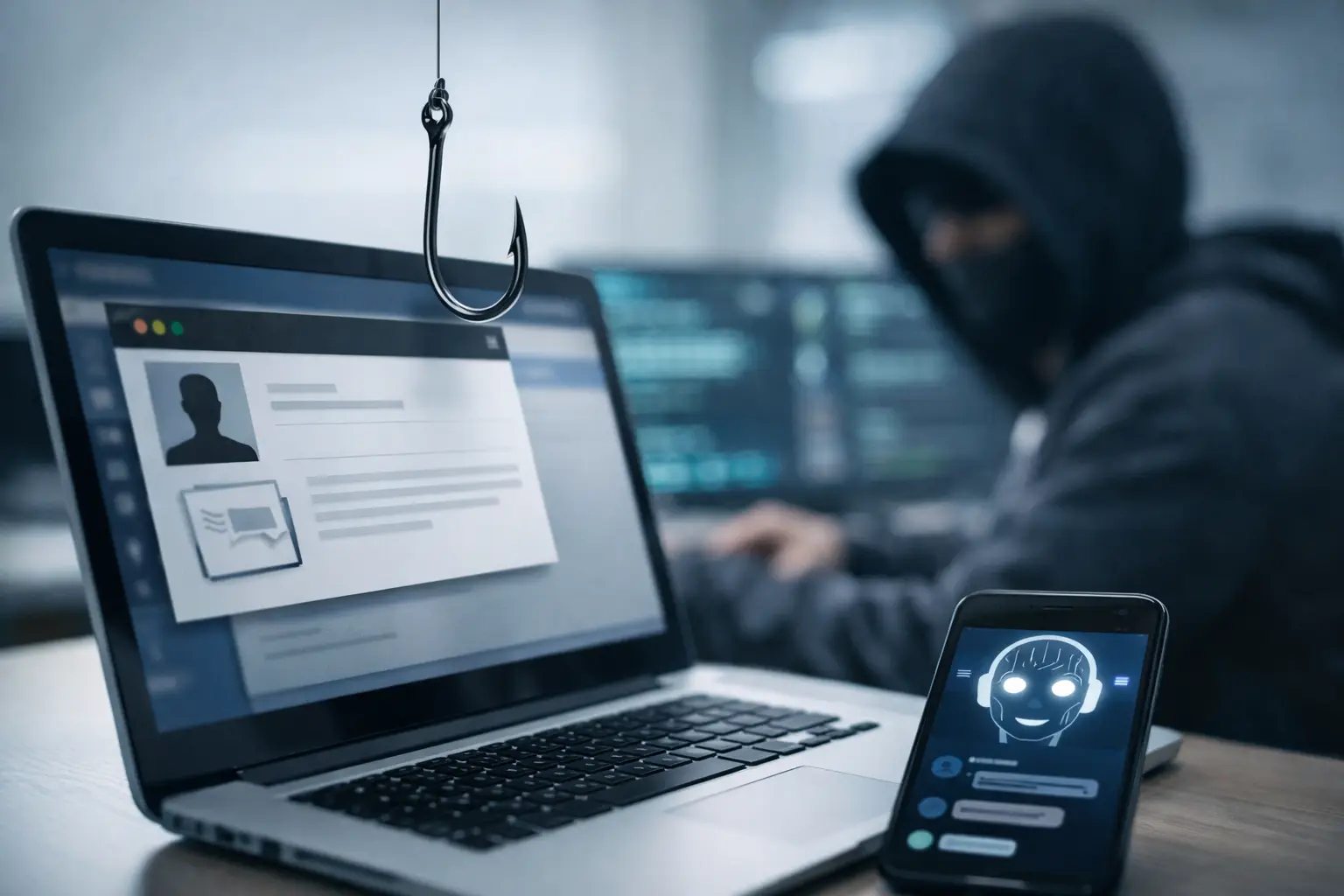
An email that captures the exact tone of a financial director, with no visible errors, sent just minutes after a legitimate payment request: this is how generative AI phishing takes root in businesses. Attackers no longer need to write poorly or target thousands of people at random. They can produce, adapt, and test messages that appear to belong to your work environment.
For a small or mid-sized business, the risk extends beyond a compromised inbox. A single click can lead to the theft of Microsoft 365 credentials, wire fraud, access to sensitive data, or the opening of a door to ransomware. Protection must therefore combine technology, verification procedures, and continuous human support.
Why generative AI phishing changes the game
Generative AI does not create an entirely new category of cyberattack. Rather, it improves the quality and speed of execution of already-known techniques: identity spoofing, credential theft, business email compromise, and CEO fraud. This difference alone is enough to shift the threat level.
For a long time, language errors, strange wording, or rough logos helped employees identify phishing attempts. These markers remain useful, but they are no longer reliable on their own. An AI tool can write a flawless message in French, English, or another language used by your teams. It can also adopt the register of a manager, condense a business exchange, or rephrase a vendor follow-up with disturbing precision.
The attacker can exploit publicly available information about your company: organizational chart, recruitment announcements, press releases, social media posts, and partner names. With these elements, they build a credible story. A finance director receives an urgent request related to an announced acquisition. An HR department receives a CV with a malicious link. An employee receives a message that appears to come from IT support and references a migration actually underway.
AI also reduces the cost of personalization. A campaign previously reserved for experienced attackers can be quickly adapted for multiple subsidiaries, business roles, and countries. The volume increases, but more importantly, the apparent relevance of each message increases.
The most dangerous scenarios for businesses
The most common risk remains the fake login page. The email invites the user to view a document, resolve a synchronization issue, or renew a Microsoft 365 session. The page mimics the legitimate portal and captures the username, password, or even the validation code if the attack poorly circumvents authentication mechanisms.
Payment fraud is particularly concerning for finance and procurement teams. An attacker who has observed exchanges between a vendor and your employees can generate a request to change banking details that is consistent with the context. They can also mimic a manager's voice during a brief call or create an urgent voice message. Neither careful writing nor a familiar voice should now constitute sufficient proof of identity.
HR, legal, and sales teams are also exposed. Attachments may contain malware, while links may lead to fraudulent sharing portals. In some cases, the goal is not to immediately trigger an infection, but to collect information to prepare a more targeted attack.
Finally, compromising a real mailbox remains one of the most difficult scenarios to detect. When an attacker uses the authentic account of a partner or employee, the message sometimes passes the most basic controls. Analysis must then focus on behavior: unusual timing, exceptional request, forwarding rule created without reason, or login from an abnormal location.
The signals to learn to verify
Awareness remains essential, but it must evolve. Asking teams to "be careful" is not enough in the face of well-constructed messages. They need simple rules that can be applied under pressure and supported by business processes.
Any sensitive request must be verified outside the channel that initiated it. For a payment, a change of bank account, an access modification, or data sharing, the team must confirm by phone using a known number, by an approved internal tool, or by an established validation procedure. Replying directly to the suspicious email does not constitute an independent verification.
Employees must also be wary of elements designed to trigger an immediate reaction: unusual urgency, excessive confidentiality, bypassing a process, promise of reward, or threat of blocking. Generative AI makes the content convincing, but it does not eliminate the attacker's need to obtain rapid action.
Effective training relies on cases close to the daily work of teams. Generic simulations have their place, but a quote request sent to a salesperson or a false invoice reminder intended for finance reveals the reflexes to strengthen better. The goal is not to trap employees, but to give them the reflex to report a doubt without fear of reprimand.
Protecting email without creating unnecessary friction
Email filtering remains an essential first line of defense. It must analyze sender domains, link reputation, attachments, spoofing attempts, and abnormal behaviors. Domain authentication controls, such as SPF, DKIM, and DMARC, reduce the ability to send messages while impersonating your organization.
These protections will not block all attacks. An email from a compromised partner account, for example, may seem technically legitimate. This is why email security must be combined with anomaly detection, conditional access policies, and activity monitoring in cloud environments.
Multi-factor authentication is essential, but not all factors are equal. Codes received by SMS or entered on a fraudulent page remain exposed to real-time phishing. When possible, phishing-resistant methods, such as security keys or device-integrated authentication, offer superior protection. The right choice depends on your tools, the maturity of your teams, and the risk level associated with the accounts involved.
Privileged accounts, executives, finance, and IT administration deserve enhanced controls. Limiting rights, separating administrative accounts, and requiring additional validation for critical actions greatly reduces the impact of a stolen credential.
A structured response when the click has happened
A click does not automatically mean a crisis is inevitable. However, every minute counts. The organization must know who to report the incident to, how to isolate a workstation if necessary, and who can revoke a session or reset access. A makeshift response often leaves the attacker continuing their activity while teams search for the right contact.
When a credential may have been compromised, recent logins, email forwarding rules, authorized applications, mailbox modifications, and attempts to access sensitive data must be examined. Resetting the password is necessary, but rarely sufficient if an active session, a persistent rule, or a third-party application has already been set up.
Endpoint monitoring provides an additional layer. If phishing leads to the download of a malicious file or the execution of a script, an endpoint detection and response solution can identify suspicious behavior and accelerate containment. Email, identities, endpoints, and the network must be treated as a single defense perimeter, not as independent silos.
Making vigilance a sustainable system
Protection against generative AI phishing is not a project to check off once a year. Tactics change, attack tools advance, and work environments transform. Effective defense relies on regularly evaluated controls, alerts handled methodically, and procedures adjusted based on observed incidents.
It is also a matter of business continuity. When payment rules are clear, access is properly protected, and teams know how to report a suspicious message, the business prevents the pressure of an urgent email from turning into a costly disruption. A cybersecurity partner can help pilot this vigilance by combining technology with expertise capable of distinguishing a minor alert from a real risk.
The right reflex is not to ask your teams to guess whether a message was written by AI. It is to build an environment where a message, however convincing, cannot by itself trigger critical action without control, without visibility, and without defense.