

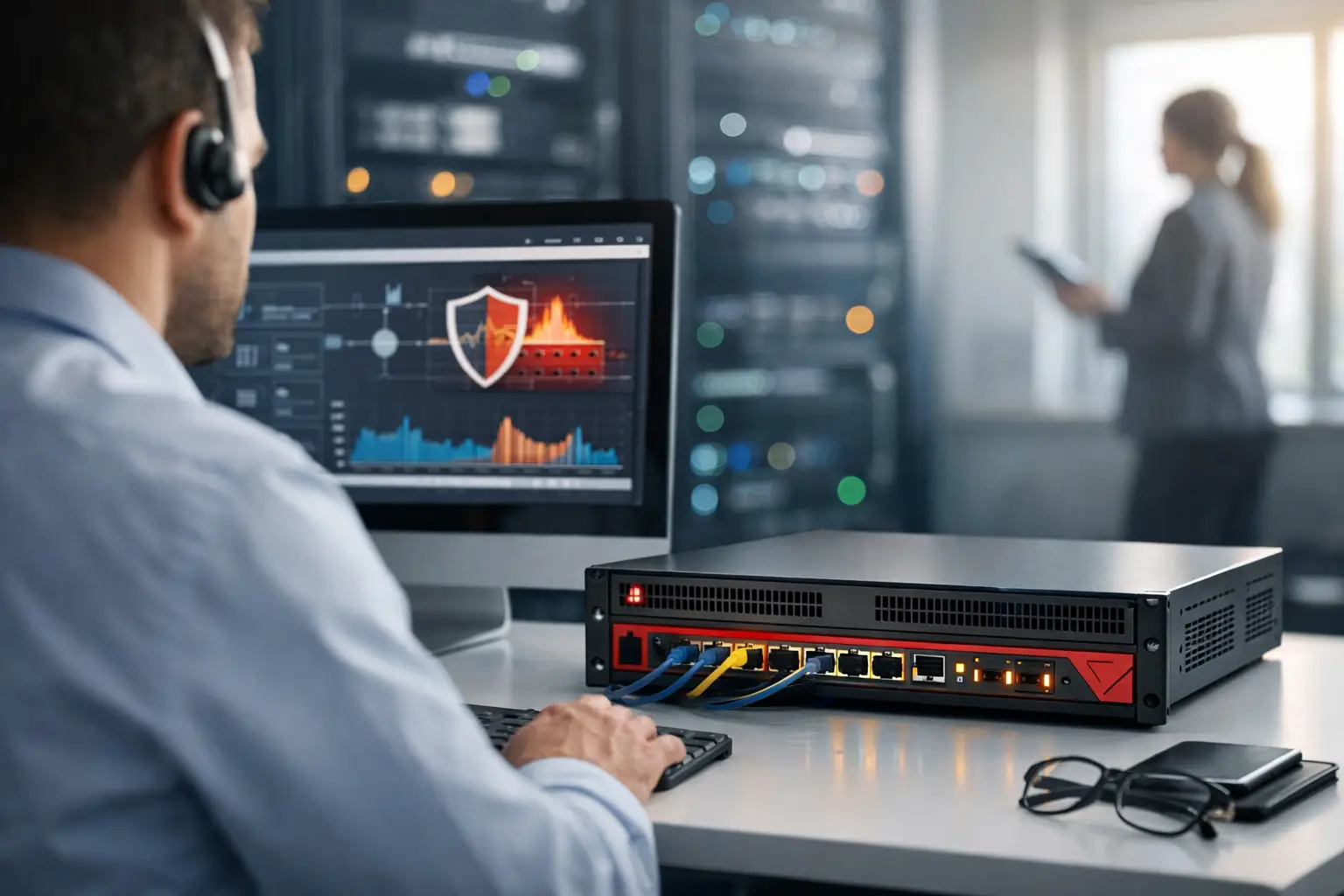
A poorly managed firewall not only blocks threats: it can also slow down a business application, interrupt remote access or leave a door open for months. This enterprise firewall management guide helps executives and IT managers transform this critical equipment into a true control point for business continuity.
The subject goes far beyond choosing an appliance or opening a port. Effective management is built on understandable rules, regular monitoring, validated decisions and a genuine ability to respond when abnormal behavior appears. For a small or mid-sized business, this is the difference between security that is imposed and a controlled defense.
Why firewall management is an operational issue
The firewall controls exchanges between your network, the Internet, your remote sites, your cloud environments and sometimes production equipment. It applies rules that determine who can access what, from where, by which protocol and when. A single overly permissive rule can expose a server, VPN access or web application to intrusion attempts.
The risk often comes from accumulation. A temporary opening requested by a vendor becomes permanent. An old server remains authorized even though it no longer exists. Rules are added in an emergency without being documented. Over time, the security policy loses clarity and teams no longer know which authorizations are still justified.
This situation also creates a business risk. When an incident occurs, a confused configuration lengthens diagnosis and delays return to normal. Conversely, a well-managed firewall allows you to quickly isolate a compromised segment, limit the spread of ransomware and preserve essential services.
Enterprise firewall management guide: starting with the right scope
Before modifying rules, you need to know what the firewall protects. The inventory must cover physical sites, Internet connections, Wi-Fi networks, remote employee access, servers, published applications and interconnections with partners. Microsoft 365 and cloud environments do not replace this analysis: they add flows, identities and dependencies to manage.
Traffic flow mapping is the most useful and most often neglected step. It is not about documenting each network packet, but about identifying essential communications: a management application that accesses a database, a remote site that joins a central tool, a service provider that works on specific equipment, or workstations that use a cloud service. Each legitimate flow must have a business or technical owner.
This approach avoids two opposite mistakes. The first is to open too widely to solve a problem quickly. The second is to block without understanding operational dependencies. The right decision depends on context, data sensitivity and the impact of an interruption. A financial server and a guest network do not require the same level of control.
Adopt the principle of least privilege
A firewall rule must authorize the minimum necessary, and nothing more. This means limiting the source, destination, service, port and, when possible, the period of application. Authorization between two entire network segments is rarely preferable to a targeted rule between an application and its server.
The principle of least privilege is particularly decisive for remote access and third-party connections. A vendor should not have access to the entire network just because they need to maintain a single system. Access must be authenticated, logged, limited in time and revoked as soon as the intervention is complete.
Segmentation complements this logic. Separating workstations, servers, administrative equipment, backups, guest Wi-Fi and connected devices reduces an attacker's lateral movements. If a workstation is compromised by phishing, the attacker should not be able to freely reach critical systems.
Build a clear and sustainable rule policy
A healthy rule base typically starts with a default deny, supplemented by explicit allows. This model requires more rigor upfront, but it provides better control over time. It also makes it possible to detect unusual requests rather than accept them out of habit.
Each rule must contain an explicit name, description, owner, justification and, ideally, a review date. For example, "ERP vendor access to application server - maintenance contract - quarterly review" is more useful than a rule named "Temp1". This discipline accelerates audits, investigations and exchanges between teams.
The order of rules also deserves careful attention. A broad rule placed before a restrictive rule can render the latter useless. Network objects, address groups and service definitions must be standardized to avoid duplicates. Clean configuration is not a matter of aesthetics: it reduces human errors during urgent changes.
You must also distinguish between permanent rules and temporary rules. Any exception related to a project, migration or troubleshooting must have an expiration date. Without this deadline, the temporary becomes a lasting exposure.
Monitor what is allowed, blocked and unusual
A firewall without usable logging is an incomplete control. Logs allow you to verify that a rule is being used as intended, identify suspicious connections and reconstruct events after an alert. They must be retained long enough to support investigations, according to the organization's internal and regulatory requirements.
However, collecting large volumes of logs is not enough. Teams must have useful thresholds, use cases and alerts. Repeated attempts to sensitive ports, unusual communication with an unexpected country, a sudden increase in outbound traffic or connections at atypical times warrant analysis. The goal is not to alert on everything, but to surface what requires a decision.
Intrusion prevention, application filtering, URL control and encrypted traffic inspection functions can strengthen protection. Their deployment should nevertheless be gradual. TLS inspection, for example, improves visibility on certain threats, but it requires adapted architecture, certificate management and analysis of impact on applications and privacy.
Manage changes to prevent avoidable incidents
Most firewall-related outages do not come from a sophisticated attack, but from poorly prepared changes. An opening request must therefore follow a simple process: needs expression, flow identification, risk validation, testing, production deployment and post-change control. This framework does not need to be heavy to be effective.
Critical modifications must provide a rollback plan. Before deploying a rule, the team must know how to return to the previous state if an application stops working. Changes outside business hours can reduce impact, but they do not replace validation and post-deployment monitoring.
Periodic review of rules is essential. Depending on the frequency of changes, it can be monthly, quarterly or semi-annual. The review should look for unused rules, obsolete objects, overly broad access, expired exceptions and services unnecessarily exposed on the Internet. It is also the time to verify that system updates, security signatures and configuration backups are properly applied.
Prepare response before an alert becomes a crisis
When suspicious behavior is detected, speed counts, but rushing can interrupt critical processes. It is therefore better to define in advance who can block an address, cut VPN access, isolate a segment or modify an emergency rule. Responsibilities between management, IT, security and service providers must be clear.
A firewall-specific response plan provides for log collection, preservation of the relevant configuration, identification of affected assets and validation of recovery. After the incident, the rule or weakness that contributed to the exposure must be corrected. Post-incident review then allows procedures to be improved rather than repeating the same emergencies.
For organizations that do not have security expertise available continuously, managed management brings structured monitoring, regular reviews and support during sensitive changes. SentriCorp can in particular combine firewall management with endpoint protection, vulnerability analysis and IT support, so that security decisions take operational realities into account.
A firewall becomes truly protective when its rules reflect your activity, when its events are monitored and when each exception remains controlled. Vigilance applied with method gives the enterprise a valuable capability: to continue its operations with confidence, even as the threat evolves.